
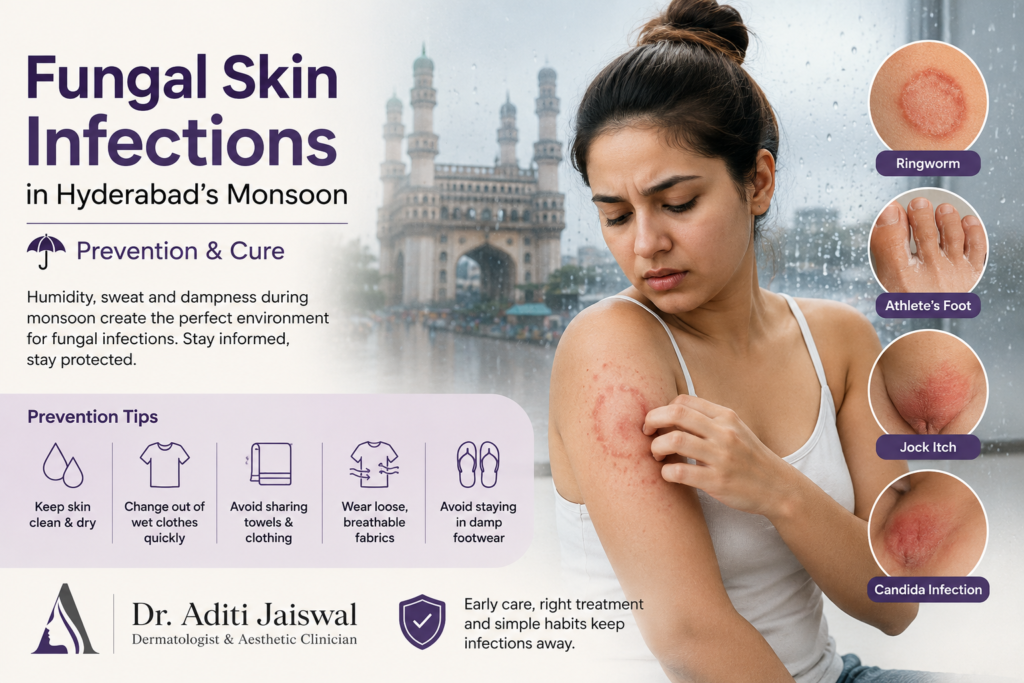
Fungal Skin Infections in Hyderabad’s Monsoon
Fungal Skin Infections in Hyderabad’s Monsoon: Prevention & Cure Fungal skin infections: Hyderabad’s monsoon brings welcome relief from the summer heat, but the same humidity that cools the air also creates perfect conditions for fungal skin infections to take hold. Understanding why this happens — and what to do about it — can save you weeks of discomfort. Why Monsoon Triggers Fungal Skin Infections Fungi thrive in warm, damp environments, and monsoon season delivers exactly that. Humidity, sweat, damp clothing, wet footwear, and reduced skin dryness during monsoon make certain body areas more vulnerable to irritation, itching, and infection. In cities that see heavy, prolonged rainfall, this effect is amplified. Dermatologists across Indian metros report a sharp seasonal spike in fungal skin conditions every year during this window, with humid regions seeing it earlier and more severely than drier ones. A compromised skin barrier makes matters worse — frequent washing combined with friction from damp fabric weakens the skin barrier, making it easier for fungi to take hold. Common Types You Might Encounter Several fungal skin infections tend to surface this time of year. Although its name suggests otherwise, ringworm is not caused by worms. It is a common fungal infection that affects the skin, hair, or nails, and it often produces an itchy, scaly, circular or ring-shaped patch. It also spreads easily during wet weather — ringworm can spread more readily in the monsoon when skin stays damp or when towels, bedding, or clothing are shared with an infected person. Feet are especially vulnerable too. Athlete’s foot affects the feet, particularly between the toes, and may cause itching, peeling, scaling, burning, or painful cracks.The groin is also a frequently affected area. Jock itch causes an itchy, scaly rash in the groin and inner thighs that worsens with sweating and friction. Skin folds aren’t spared either, since candida can overgrow in moist skin folds, producing a bright or dark red, uncomfortable rash, sometimes with small satellite spots around the edges. In Hyderabad specifically, certain lifestyle factors add extra risk. In India, these infections often rise during monsoon, especially among people who walk long distances, wear socks for extended hours, or share footwear, and children, teenagers, and men tend to be more vulnerable, particularly to scalp ringworm, jock itch, and athlete’s foot. Recognizing Serious Signs Most fungal skin infections start small but shouldn’t be ignored. In more severe cases, blisters or pus-filled sores can develop, especially with scratching or a secondary bacterial infection. See a dermatologist promptly if the rash spreads, keeps returning, affects the nails or scalp, causes pain, involves multiple areas, or doesn’t improve with basic care. Prevention: Simple Habits That Actually Work The good news is that prevention doesn’t require expensive products. Dermatologists agree that prevention remains the most effective strategy, and it doesn’t require expensive skincare routines. Practical daily habits go a long way: keep skin clean and dry, change out of wet clothing quickly, dry thoroughly between the toes, avoid sharing towels, choose breathable clothing, and avoid staying in damp footwear. Treatment: What Dermatologists Recommend If an infection develops, targeted treatment usually cures it. A localized fungal skin infection may be treated with an antifungal cream, lotion, or gel, used exactly as directed and for the full course, even if itching improves early. Recovery time varies: skin infections may improve within a few weeks with appropriate treatment, while scalp and nail infections often need longer courses. One important caution: avoid reaching for random anti-itch creams from the pharmacy. Some anti-itch creams contain steroids that may briefly reduce redness but can worsen fungal infections if used without a dermatologist’s guidance. Diagnosis itself may need more than a glance, since a skin scraping, nail sample, or fungal culture is often more useful than routine blood tests for confirming a superficial fungal skin infection, and testing matters because fungal infections can resemble other skin conditions like eczema or psoriasis. The Takeaway Hyderabad’s monsoon doesn’t have to mean a season of itchy, recurring rashes. Staying dry, changing out of wet clothes promptly, choosing breathable fabrics, and treating early signs seriously can prevent most fungal skin infections — and if something doesn’t clear up within a couple of weeks, a dermatologist visit is the safer next step than self-treating indefinitely.
Fungal Skin Infections in Hyderabad’s Monsoon Read More »